Accept source evidence without allowing a telemetry vendor or model provider to define Epistema’s meaning.
Technical diligence route
Inspect the foundation—not only the presentation.
See what is implemented, how evidence becomes governed workflow state, where interpretation is constrained, and which claims remain provisional or outside current scope.
Active architecture
See the current boundary before inspecting its parts.
This active model supersedes the provisional public visual while preserving its underlying semantic discipline. It separates external platform responsibilities, carrier transport, Epistema assurance, readouts, admission, and downstream state.
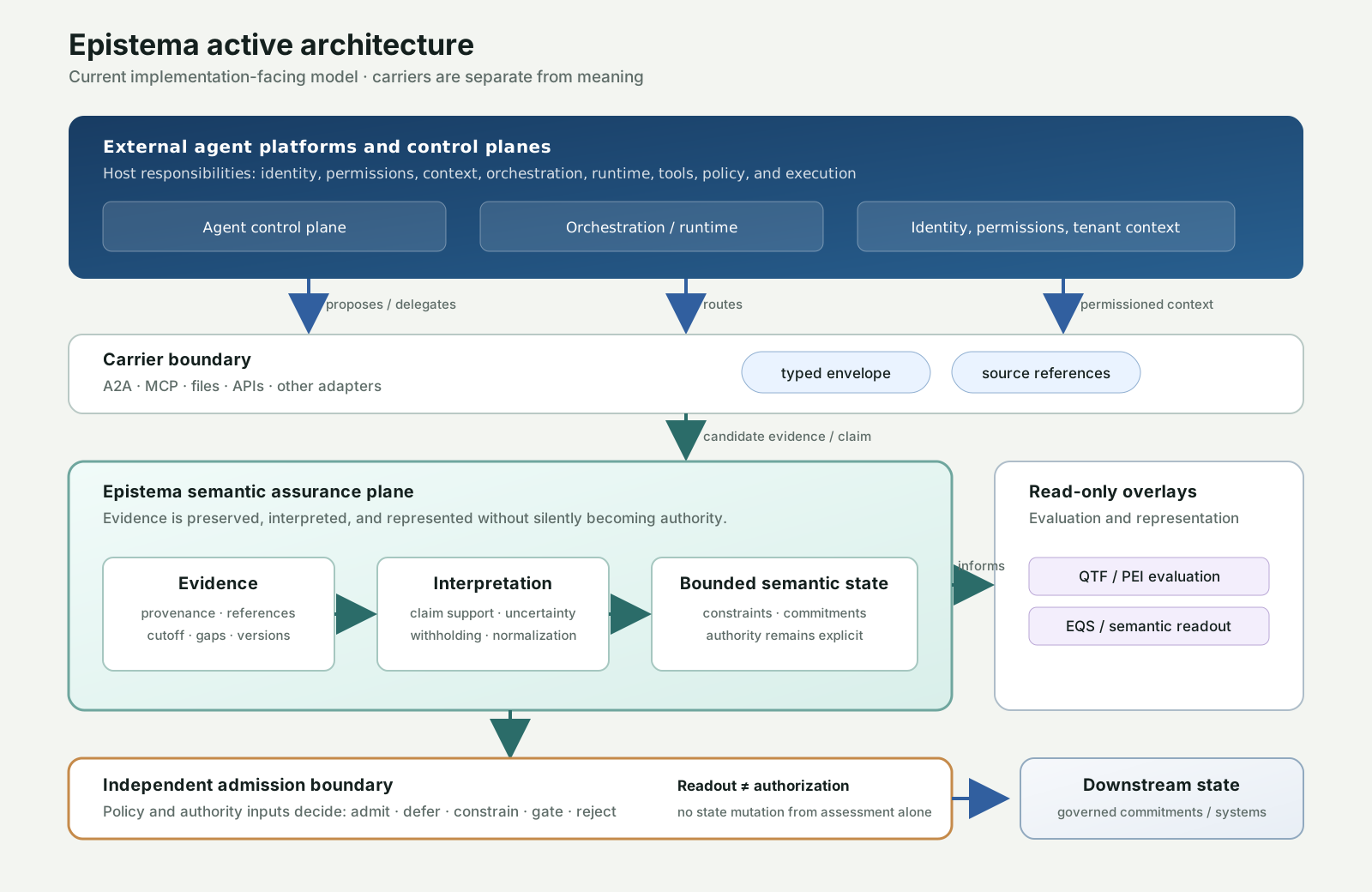 Open the active architecture with a plain-language walkthrough.
Promote evidence conservatively through an explicit interpretation boundary into governed workflow state.
Keep commitment records, QTF and PEI readouts, and the Workflow Value Ledger distinct but connected.
Epistemic firewall
Evidence does not become meaning by accident.
Provider vocabulary, eval scores, and telemetry remain source evidence until an explicit interpretation step promotes them into typed workflow semantics. Representation remains downstream.
Traces, records, artifacts, scores, corrections, costs, and source provenance.
Conservative promotion, role assignment, withholding, and explicit uncertainty.
Typed workflow states, transitions, constraints, commitments, and resolutions.
Workflow Value Ledgers, queries, reports, consoles, diagrams, and readouts.
Current status
Bounded implementation, explicit exclusions.
The public proof is designed to make maturity inspectable. “Implemented” means a bounded, test-backed slice—not a production claim.
Import Evidence
Local JSON and CSV submissions support deterministic validation, conservative classification, evidence-window summaries, and a ledger preview.
Open the first-run path →Workflow Value Ledger v0.2
A pure-function layer derives commitment status, evidence-qualified value signals, explicit optional-input states, and a recommended next action.
Open the illustrative readout →Reference Path
Work-item, Opik, and OTel-shaped fixtures pass through one structured report contour while retaining source-specific evidence.
See the bounded review motion →MCP scaffolds
Local contracts, stdio compatibility, persistence, validation, error envelopes, and governed readouts exist. This is not a production MCP service.
Request controlled MCP diligence →QTF and PEI
Evaluation readouts remain subordinate to the semantic boundary. They do not define source truth or silently become semantic state.
See their architectural role →A2A assurance endpoint
A published Agent Card and HTTPS endpoint support a read-only semantic-assurance handoff, including a bounded Microsoft Foundry round trip.
Inspect the boundary →Enterprise platform controls
Enterprise identity, tenant routing, deployment, scaling, and policy enforcement are supplied by the surrounding platform and integration design.
Discuss the integration path →Data and trust boundary
Customer-approved evidence enters. Human authority remains outside the model.
Epistema does not require unrestricted raw enterprise data. Evidence may arrive through structured files, approved exports, redacted summaries, source references, or bounded adapters.
Customer and steward responsibilities
- Lawful collection, classification, consent, and permitted use
- Source-system access, minimization, redaction, and retention
- Applicable privacy, security, compliance, and governance rules
- Final authority over organizational commitment
Epistema responsibilities
- Operate on authorized submitted or connected evidence
- Preserve provenance, gaps, withholding, and uncertainty
- Keep provider metadata from silently defining meaning
- Respect agreed handling boundaries in an implemented deployment
Current limitation: production identity, access management, tenant isolation, deployment security, and policy enforcement are implementation responsibilities, not features of the current bounded prototype.
Live bounded milestone
Agent-to-agent transport now carries the assurance handoff.
A Microsoft Foundry agent discovers and invokes a deployed Epistema assurance endpoint through A2A over HTTPS, submits a candidate assessment, and receives a completed read-only semantic readout. This is a working proof of the assurance handoff across an agent boundary.
What the proof establishes
- Agent Card discovery and a standards-based HTTPS endpoint
- Foundry-to-Epistema A2A invocation
- Typed readout fields for disposition, evidence, gaps, and posture
- Fabricated approval evidence is deferred rather than accepted
- Readout does not grant authority or mutate governed state
What remains outside the claim
- Foundry A2A is still a preview surface
- Bearer authentication is transport authentication, not tenant or commitment authority
- Native typed-data placement through Foundry is not established on the tested path
- Tenant isolation, source attestation, and delegated identity remain open
- Work IQ integration and production readiness remain future work
Interpretation: Epistema complements the host platform. The platform may provide identity, permissions, context, orchestration, evaluation, guardrails, and execution; Epistema asks whether the proposed consequential commitment is supported by the evidence and authority available at that point.
Proof trail
Different claims require different proof.
Architecture, fixtures, demonstrations, regressions, and milestones are kept distinct. A polished demo does not stand in for executable evidence.
Reference architecture
Implementation-facing system truth for ingestion, governance semantics, evaluation, and ledger output.
Open architecture →Claim-to-proof map
Maps public demonstrations to fixtures, tests, regressions, milestones, and limitations.
Request controlled access →Platform baseline
Positions Epistema beside AI platforms, orchestration, agent control planes, governance, and evaluation categories.
Request the positioning note →Implementation scope
The canonical implemented, canonicalized, provisional, and excluded status matrix.
Request the scope record →Governance console
A static bounded demo of ready, constrained, blocked, and missing-evidence states.
Open console →Product surface
Operator, manager, and executive questions mapped to current public surfaces.
Review the public product boundary →Full resource index
Technical, strategic, pilot, research, and reference materials grouped by purpose.
Open resources →