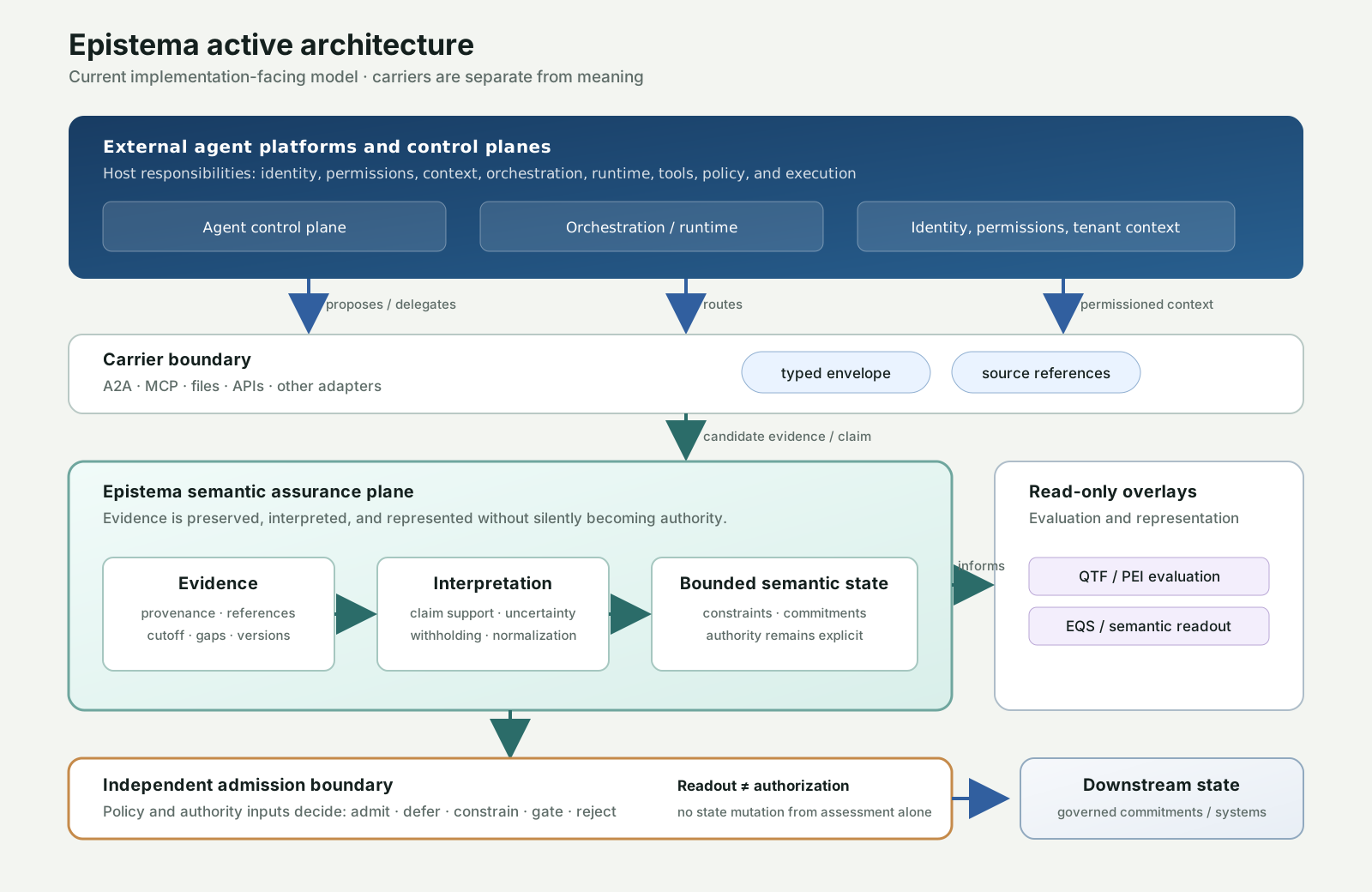
The diagram is organized around responsibilities and boundaries. It is the current implementation-facing model; the older three-band Figure 8 remains preserved as historical/provisional lineage.
1. Ingestion and normalization
Question: What enters Epistema, and how is source meaning preserved?
Telemetry, evaluations, chats, agent events, work records, artifacts, costs, and decisions can arrive from different carriers. The normalization layer retains source provenance while translating records into a common candidate-event shape.
2. Semantic and governance core
Question: How does activity become governed workflow meaning?
The semantic contract boundary preserves the sequence Evidence → Interpretation → Semantic State → Representation. Interpretation is the epistemic firewall: evidence can be promoted, withheld, or left contextual, but it cannot silently become organizational truth.
The ACTECRU lifecycle—Admission, Classification, Transformation, Evaluation, Commitment, Resolution, and Update—operates over typed states, transitions, constraints, evidence, and commitments.
3. Decision and evaluation outputs
Question: What can leaders and practitioners actually review?
A formal commitment record remains distinct from model output. QTF examines the quality of a transformation; PEI examines productive expansion. Both can inform—but neither can define—the Workflow Value Ledger or make the final decision.
High PEI with low QTF can mean more movement than progress—dangerous leverage when weak reasoning scales.
What the architecture protects
- Telemetry is evidence, not ontology.
- A model answer is not automatically an organizational commitment.
- Evaluation readouts do not silently become semantic state.
- The Workflow Value Ledger records what the evidence supports, including gaps and withheld claims.
- Human authority remains outside the model.
Current architecture scope
The current implementation contains bounded import, normalization, reference-path, ledger, query, MCP-contract, fixture, and regression slices. It does not yet contain a production enterprise platform with tenant isolation, deployment controls, authentication, a live adapter registry, or calibrated universal QTF and PEI scoring.